Monday, November 10, 2008

Morgan Manipulates Silver Market

There is compelling new proof of a silver (and gold) price manipulation. The evidence connects the investment bank JP Morgan Chase, the dominant force in world commodity trading, the U.S. Commodity Futures Trading Commission (CFTC), the primary commodity regulator, and the U.S. Treasury Department, the arranger of every conceivable bailout.

This week, I received a copy of a letter, dated October 8, sent from the CFTC to a California Congressman, Gary G. Miller. It discussed allegations of a silver market manipulation because of the data in the monthly Bank Participation Report. The data in that report for August showed that one or two U.S. banks held a massive short position in COMEX silver futures of 33,805 contracts, or more than 169 million ounces. This is equal to 25% of annual world mine production, and was up more than five-fold from the prior month’s report. After this position was established, silver prices fell more than 50%, in spite of a widespread shortage in retail forms of investment silver. Never before had there been a such a large concentrated position in any market, including every manipulation case in the CFTC’s history. Concentration and manipulation go hand in hand. You can’t have one without the other.

The letter was sent to me by a reader who had the foresight to write to his Congressman. Of course, the CFTC denied that a silver manipulation existed, as they always have. This proves that the Commission responds much quicker to a member of Congress than it does to hundreds of ordinary citizens and investors. In the future, should you decide to write to the CFTC, be sure to do so through your elected representatives.

What was remarkable (and disturbing) about the letter was that it strongly confirms an analysis I presented in an article dated September 2, titled, "Fact Versus Speculation" http://www.investmentrarities.com/09-02-08.html. In that article, I speculated that the shocking increase in the silver short position by one or two U.S. banks was related to the takeover of Bear Stearns by JP Morgan in March.

Here’s a quote from my article, dated September 2.

"I am going to speculate based upon the known facts. Maybe I will be proven correct, maybe not. However, the nature of this speculation is so disturbing, that I hope I am wrong. But I need to state it because if I am close to the mark, the implications for the silver market are profound.

I think the data in the COT and the Bank Participation Reports indicate that the U.S. Government may have bailed out the biggest COMEX silver short by arranging for a U.S. bank to take over their position. This coincides with JP Morgan’s takeover of Bear Stearns. In fact, it would not surprise me if the bailout was JP Morgan taking over Bear Stearns‘ short silver position, at the government‘s request. While this silver bailout (if it happened) was no doubt undertaken with financial system stability in mind, it has disturbing implications of legality and equity"

This is the relevant quote from the CFTC’s Oct 8 letter.

"In effect the increase [in the short position] reflected a one time acquisition of positions that were acquired through a merger in the industry, and not new trading by a bank. Thus, the assertion that there was new activity undertaken by the banks that led to a fall in silver prices is not correct since the "new" activity reflected in the CFTC’s report was in essence positions that had already existed in the market prior to July 1st."

The CFTC clearly confirms, in effect, that the big silver short position was related to JP Morgan’s takeover of Bear Stearns, since no other merger provides a plausible explanation. However, the Commission is not speaking truthfully about an increase in the concentrated short position. The CFTC’s own data, in weekly Commitment of Traders Reports (COT), show a sizable increase in concentrated short positions of some 12,000 contracts (60 million ounces) from levels before July 1st to the August Bank Participation Report.

More importantly, the real issue is not about when the one or two U.S. banks increased their short position, but how large that short position grew in the August Bank Participation Report. The CFTC is deceiving a U.S. Congressman by attempting to reduce the argument to when the short position was increased, not the obscene and manipulative size of the position. This is deception through omission and misrepresentation. What difference does it make when the manipulative position was established? The issue is how can a short position of 25% of the world production of any commodity, held by one or two U.S. banks, not be manipulative?

Bear Stearns held the largest concentrated short position in COMEX silver (and gold) futures at the time of its forced merger with JP Morgan in March. That position was not discovered until the publishing of the August Bank Participation Report followed by the October 8 letter from the CFTC to Congressman Miller. Furthermore, Bear Stearns had no legitimate backing to the short silver position, either in actual metal or cash. Otherwise it could have been delivered against or bought back, just as would have happened were it a long position.

The price of silver at the time of Bear Stearns implosion was $20 to $21 an ounce. A free market covering of a concentrated short position of this size would have driven silver prices to the $50 or $100 level and would have exposed the long-term manipulation. Rather than let the free market deal with the required short covering of such an uneconomic and unbacked short position, government authorities arranged to have the short position transferred to JP Morgan. This was undertaken by the U.S. Treasury Department, along with taxpayer guarantees against loss to Morgan worth billions of dollars. This was done, no doubt, to save the financial system from imploding. This was also patently illegal, as it aided and abetted the silver manipulation.


JP Morgan was not just an accommodative good corporate citizen in the illegal transfer of the manipulative silver (and gold) COMEX short position. In addition to undisclosed government guarantees against loss, JP Morgan was given free reign to liquidate the COMEX short position at their discretion, knowing full-well the regulators would look the other way, no matter what dirty tricks were necessary to cause the price to collapse. Nor was JP Morgan a neutral agent in the silver price collapse. Data from the Office of the Comptroller of the Currency (OCC) http://www.occ.gov/deriv/deriv.htm indicates that JP Morgan held a much larger Over The Counter (OTC) derivatives position in silver and gold than was transferred to them from Bear Stearns.

My analysis shows that Morgan has made many billions of dollars, perhaps tens of billions, from their downward engineering of silver and gold prices from their combined COMEX and OTC short positions. They have used that engineered price decline to buy back as many short positions as possible. If investors are wondering what caused the destruction of billions of dollars in gold and silver values, metal and share price alike, look no further than JP Morgan, and the government officials who enabled them.

There can be no question that the CFTC is complicit in all these illegal activities. Same with the CME Group, owner of the NYMEX/COMEX. It is not possible that they are not privy and an active party to this successful downward manipulation. To think that officials at the CFTC, from the top of the agency, to staffers and even the Inspector General, have taken oaths of office to uphold commodity law and then have allowed that law to be repeatedly violated is beyond repugnant. That they have knowingly participated in an organized cover-up of this manipulation and have taken to lying to a Congressman calls for criminal prosecution.


Ted Butler

Bloomberg Sues Fed to Force Disclosure of Collateral

Why on earth would Americans ever need to know what their tax dollars are buying?


By Mark Pittman

Nov. 7 (Bloomberg) -- Bloomberg News asked a U.S. court today to force the Federal Reserve to disclose securities the central bank is accepting on behalf of American taxpayers as collateral for $1.5 trillion of loans to banks.

The lawsuit is based on the U.S. Freedom of Information Act, which requires federal agencies to make government documents available to the press and the public, according to the complaint. The suit, filed in New York, doesn't seek money damages.

``The American taxpayer is entitled to know the risks, costs and methodology associated with the unprecedented government bailout of the U.S. financial industry,'' said Matthew Winkler, the editor-in-chief of Bloomberg News, a unit of New York-based Bloomberg LP, in an e-mail.

The Fed has lent $1.5 trillion to banks, including Citigroup Inc. and Goldman Sachs Group Inc., through programs such as its discount window, the Primary Dealer Credit Facility and the Term Securities Lending Facility. Collateral is an asset pledged to a lender in the event that a loan payment isn't made.

The Fed made the loans under 11 programs in response to the biggest financial crisis since the Great Depression. The total doesn't include an additional $700 billion approved by Congress in a bailout package.

Fed's Position

Bloomberg News on May 21 asked the Fed to provide data on the collateral posted between April 4 and May 20. The central bank said on June 19 that it needed until July 3 to search out the documents and determine whether it would make them public. Bloomberg never received a formal response that would enable it to file an appeal. On Oct. 25, Bloomberg filed another request and has yet to receive a reply.

The Fed staff planned to recommend that Bloomberg's request be denied under an exemption protecting ``confidential commercial information,'' according to Alison Thro, the Fed's FOIA Service Center senior counsel. The Fed in Washington has about 30 pages pertaining to the request, Thro said today before the filing of the suit. The bulk of the documents Bloomberg sought are at the Federal Reserve Bank of New York, which she said isn't subject to the freedom of information law.

``This type of information is considered highly sensitive, and it would remain so for some time in the future,'' Thro said.

To contact the reporter on this story: Mark Pittman in New York at mpittman@bloomberg.net. Last Updated: November 7, 2008 12:39 EST

AIG: Bailed out again

Fed restructures loan and creates 2 programs to rescue insurance giant from bad bets. Treasury buys $40 billion in shares. AIG quarterly loss: $25 billion.

By David Goldman, CNNMoney.com staff writer

NEW YORK (CNNMoney.com) -- Troubled insurer American International Group got a new, $150 billion deal from the federal government on Monday, as the Federal Reserve and Treasury Department made significant changes to the terms of the company's original bailout.

The Fed announced that it will reduce AIG's original $85 billion bridge loan to $60 billion, and it will reduce the interest rate by 5.5 percentage points.

In addition, the Treasury will use its special authority under last month's $700 billion bailout law - the so-called Troubled Asset Relief Program - to purchase $40 billion in preferred stock.


The Fed will also create a new program that will purchase up to $22.5 billion of AIG's troubled mortgage-backed securities, and post $30 billion to backstop its credit default swap agreements, taking place of the $37.8 billion lending facility it previously offered the company.

Also on Monday, AIG reported that it lost $24.5 billion, or $9.05 per share, in the third quarter. Excluding one-time charges, AIG lost $9.2 billion, or $3.42 per share, in the three months ended Sept. 8. That compares to a gain of $1.35 per share during the same period a year ago.

The giant insurer, which has more than 100,000 employees worldwide, reported revenue of $11.7 billion, down 0.8% from the $11.8 billion the company reported in the third quarter of 2007.

The new bailout marks a stunning turn in the Bush administration's efforts to address the escalating financial crisis. It is likely to stoke calls from those advocating for federal rescue plans for other troubled companies such as automaker General Motors, which said Friday it was running dangerously low on cash.


As part of the new deal announced Monday, Treasury will limit "golden parachutes" for AIG executives and freezing the size of the annual bonus pool for the top 70 company execs.

In mid-September, AIG teetered on collapse, pressured by the effects of the credit crisis. Worried that the company's failure would domino through the rest of the financial system, the government provided AIG with an $85 billion bridge loan. Later, the Fed gave the insurer $37.8 billion line of credit, and made available $20.9 billion in a debt purchasing facility.

The company has recently said the high interest rate on the original loan is too punitive, and AIG is having trouble selling off its subsidiaries in order to pay back the loan. Furthermore, the company's investors continued to demand the insurer post collateral to back its credit default swap agreements, forcing AIG to borrow more and more from the government.

Sunday, November 9, 2008

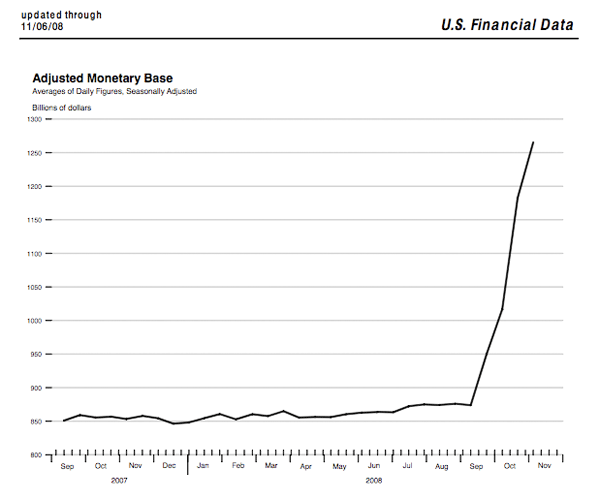
Why Inflation is Imminent


This is a chart of the amount of money added to the system. That money has to go somewhere. I think inflation is around the bend.


Stunned Icelanders Struggle After Economy’s Fall

November 9, 2008


REYKJAVIK, Iceland — The collapse came so fast it seemed unreal, impossible. One woman here compared it to being hit by a train. Another said she felt as if she were watching it through a window. Another said, “It feels like you’ve been put in a prison, and you don’t know what you did wrong.”

This country, as modern and sophisticated as it is geographically isolated, still seems to be in shock. But if the events of last month — the failure of Iceland’s banks; the plummeting of its currency; the first wave of layoffs; the loss of reputation abroad — felt like a bad dream, Iceland has now awakened to find that it is all coming true.

It is not as if Reykjavik, where about two-thirds of the country’s 300,000 people live, is filled with bread lines or homeless shanties or looters smashing store windows. But this city, until recently the center of one of the world’s fastest economic booms, is now the unhappy site of one of its great crashes. It is impossible to meet anyone here who has not been profoundly affected by the financial crisis.

Overnight, people lost their savings. Prices are soaring. Once-crowded restaurants are almost empty. Banks are rationing foreign currency, and companies are finding it dauntingly difficult to do business abroad. Inflation is at 16 percent and rising. People have stopped traveling overseas. The local currency, the krona, was 65 to the dollar a year ago; now it is 130. Companies are slashing salaries, reducing workers’ hours and, in some instances, embarking on mass layoffs.

“No country has ever crashed as quickly and as badly in peacetime,” said Jon Danielsson, an economist with the London School of Economics.

The loss goes beyond the personal, shattering a proud country’s sense of itself.

“Years ago, I would say that I was Icelandic and people might say, ‘Oh, where’s that?’ ” said Katrin Runolfsdottir, 49, who was fired from her secretarial job on Oct. 31. “That was fine. But now there’s this image of us being overspenders, thieves.”

Aldis Nordfjord, a 53-year-old architect, also lost her job last month. So did all 44 of her co-workers — everyone in the company except its owners. As many as 75 percent of Iceland’s private-sector architects have probably been fired in the past few weeks, she said.

In a strange way, she said, it is comforting to be one in a crowd. “Everyone is in the same situation,” she said. “If you can imagine, if only 10 out of 40 people had been fired, it would have been different; you would have felt, ‘Why me? Why not him?’ ”

Until last spring, Iceland’s economy seemed white-hot. It had the fourth-highest gross domestic product per capita in the world. Unemployment hovered between 0 and 1 percent (while forecasts for next spring are as high as 10 percent). A 2007 United Nations report measuring life expectancy, real per-capita income and educational levels identified Iceland as the world’s best country in which to live.

Emboldened by the strong krona, once-frugal Icelanders took regular shopping weekends in Europe, bought fancy cars and built bigger houses paid for with low-interest loans in foreign currencies.

Like the Vikings of old, Icelandic bankers were roaming the world and aggressively seizing business, pumping debt into a soufflĂ© of a system. The banks are the ones that cannot repay tens of billions of dollars in foreign debt, and “they’re the ones who ruined our reputation,” said Adalheidur Hedinsdottir, who runs a small chain of coffee shops called Kaffitar and sells coffee wholesale to stores.

There was so much work, employers had to import workers from abroad. Ms. Nordfjord, the architect, worked so much overtime last year that she doubled her salary. She was featured on a Swedish radio program as an expert on Iceland’s extraordinary building boom.

Two months ago, her company canceled all overtime. Two weeks ago, it acknowledged that work was slowing. But it promised that there would be enough to last through next summer.

The next day, everyone was herded into a conference room and fired.

Employers are hurting just as much as employees. Ms. Hedinsdottir has laid off seven part-time employees, cut full-time workers’ hours and raised prices. The Kaffitar branch on Reykjavik’s central shopping street was perhaps half full; in normal times, it would have been bursting at its seams.

While business is dwindling, costs are soaring. When the government took over the country’s failing banks in October, Ms. Hedinsdottir’s latest shipment of coffee — more than 109,000 pounds — was already on the water, en route from Nicaragua. She had the money to pay for it, but because the crisis made foreign banks leery of doing business with Iceland, she said, she was unable to convert enough cash into foreign currency.

“They were calling me every day and asking me what the situation was, and they got really nervous,” Ms. Hedinsdottir said of her creditors. They got so nervous that they sent the coffee to a warehouse in Hamburg, Germany, where it now sits while she tries to find the foreign currency to pay for it.

Her fixed costs are no longer fixed. Five years ago, the company built a new factory, borrowing the 120 million kronur — about $1.5 million — in foreign currencies. But the currency’s fall has increased her debt to 200 million kronur. This summer, her monthly payments were 2.5 million kronur; now they may be double that — the equivalent of $38,500 in Iceland’s debased currency.

“My financial manager is talking to the banks every day, and we don’t know how much we’re supposed to pay,” Ms. Hedinsdottir said.

In a recent survey, one-third of Icelanders said they would consider emigrating. Foreigners are already abandoning Iceland.

Anthony Restivo, an American who worked this fall for a potato farm in eastern Iceland and was heading home, said all of the farm’s foreign workers abruptly left last month because their salaries had fallen so much. One man arrived from Poland, he said, then realized how little the krona was worth and went home the next day.

At the Kringlan shopping center on the edge of Reykjavik, Hronn Helgadottir, who works at the Aveda beauty store, said she could no longer afford to travel abroad. But the previous weekend, she said, she and her husband had gone for a last trip to Amsterdam, a holiday they had paid for months ago, when the krona was still strong.

They ate as cheaply as they could and bought nothing. “It was strange to stand in a store and look at a bag or a pair of shoes and see that they cost 100,000 kronur, when last year they cost only 40,000,” she said.

In Kopavogur, a suburb of Reykjavik, Ms. Runolfsdottir, the recently fired secretary, said she had worried for some time that Iceland would collapse under the weight of inflated expectations.

“If you drive through Reykjavik, you see all these new houses, and I’ve been thinking for the longest time, ‘Where are we going to get people to live in all these homes?’” she said.

The real estate firm that used to employ Ms. Runolfsdottir built about 800 houses two years ago, she said; only 40 percent have been sold.

By Icelandic law, Ms. Runolfsdottir and other fired employees have three months before they have to leave their jobs. At the end of that period, she will start drawing unemployment benefits.

Meanwhile, her husband’s modest investment in several now-failed Icelandic banks is worthless. “They were encouraging us to buy shares in their firms until the last minute,” she said.

She feels angry at the government, which in her view has mishandled everything, and angry at the banks that have tarnished Iceland’s reputation. And while she has every sympathy with the hundreds of thousands of foreign depositors who may have lost their money, she wonders why the Icelandic government — and, in essence, the Icelandic people — should have to suffer more than they already have.

“We didn’t ask anyone to put their money in the banks,” she said. “These are private companies and private banks, and they went abroad and did business there.”

Despite all this, Icelanders are naturally optimistic, a trait born, perhaps, of living in one of the world’s most punishing landscapes and depending for so much of their history on the fickle fishing industry. The weak krona will make exports more attractive, they point out. Also, Iceland has a highly educated, young and flexible population, and has triumphed after hardship before.

Ragna Sara Jonsdottir, who runs a small business consultancy, said she had met for the first time with other businesses in her office building. “We sat down and said, ‘We all have ideas, and we can help each other through difficult times,’ ” she said.

But she said she was just as shocked as everyone else by the suddenness, and the severity, of the downturn. When the prime minister, Geir H. Haarde, addressed the nation at the beginning of October, she said, her 6-year-old daughter asked her to explain what he had said.

She answered that there was a crisis, but that the prime minister had not told the country how the government planned to address it. Her daughter said, “Maybe he didn’t know what to say.”

Friday, November 7, 2008

World Killer

Morgan is the quintessential leviathan in the Interest Rate arena through their obscenely sized Medium-Term Interest Rate Swap book which stood at 59 Trillion at June 30, 2008.

The interest rate swap book, due to its sheer size, overwhelms the bond complex by creating artificial demand for government securities. This interest rate suppressive activity began in earnest back in the 1990's and has kept market rates of interest at artificially low levels. The FUNDAMENTAL [and ongoing] MISPRICING of CAPITAL - for many years - has led to a myriad of economic excesses like the Dot Com boom, subsequent housing boom and the financial asset boom itself.


Morgan's overbearing effect in the interest rate complex required the simultaneous suppression of the gold price. This was done to make falsified inflation data seem credible.


It has often been said that, "if real inflation heats up - BOND VIGILANTES would raise market rates of interest reflective of real inflation". The reality folks, the BOND VIGILANTES are extinct - they lost their jobs long ago - being swallowed by the black hole that is J.P. Morgan's derivatives book.


This is documented in a laundry list of articles archived at Kirbyanalytics.com.


"I fear that we are dealing with something far different at this time.

They have unleashed the forces of chaos upon us.

We witness the western governments giving their Treasuries the power to directly tap the income of the citizens to use in market manipulation.

The joke is that they are giving the citizen's wealth to the very same people who caused this debacle.

So much for the myth of humans having intelligent, discerning minds!

So now we know the rules.


Of course, the reason why J.P. Morgan's financial adventure-ism has not yet landed them in the financial dog-house is no doubt rooted in this:

Dawn Kopecki reported [spring of 2006] in BusinessWeek Online in a piece titled, Intelligence Czar Can Waive SEC Rules,

"President George W. Bush has bestowed on his intelligence czar, John Negroponte, broad authority, in the name of national security, to excuse publicly traded companies from their usual accounting and securities-disclosure obligations. Notice of the development came in a brief entry in the Federal Register, dated May 5, 2006, that was opaque to the untrained eye."


Folks need to realize that J.P. Morgan "IS" the Federal Reserve.


They undoubtedly have a "pass". This becomes clear when one stops and really analyzes the words of Dallas Federal Reserve President, Richard Fisher;

"The Federal Reserve will do what it takes to maintain its credibility, which is central to preserving the integrity of the US dollar," Dallas Federal Reserve Bank President Richard Fisher said on Tuesday.

This report, from Reuters, continues: "We seek to get it right. And the answer to your question is we will do what gets it right," said Fisher.

Answering audience questions after a speech to the Dallas Friday Group, Fisher said the US dollar is a "faith-based currency" dependent on the credibility of a central bank.

"In addition to a faith-based currency, we are the currency of the world and we must maintain its integrity..."

Don't you just love the way they maintain the faith, their credibility and keep getting it right?

This rancid injustice has already led to the situation where COMEX futures precious metal's prices have decoupled from, and bear no resemblance to the costs of obtaining physical stocks of the same.

This appears to have also happened in the interest rate complex with Libor [London Inter Bank Offered Rate - a futures generated price] becoming a poor proxy for where banks will actually lend money.

How long before this fecal odor infects the energy complex leading to the demise of the petro-dollar is anyone's guess?

Are you a believer?

Rob Kirby

email: rkirby@kirbyanalytics.com
website: Kirby Analytics

Subscribe to the Kirbyanalytics News Letter; insightful proprietary economic analysis.

Losses Continue with Bond Insurers

Losses at bond insurers MBIA Inc. and Ambac Financial Group Inc. widened in the third quarter from a year ago because of their exposure to the U.S. residential mortgage market.

Results sent shares of both companies tumbling on the New York Stock Exchange. Meanwhile, Moody's Investors Service on Wednesday lowered its rating on Ambac's bond insuance units by four notches to Baa1. The downgrade could force the company to make sizable payments under some of its contracts

Separately, Ambac on Wednesday filed suit against EMC Mortgage Corp., a former mortgage unit of Bear Stearns Cos., claiming the investment bank leveraged its reputation and dominance in mortgage finance to entice companies like Ambac to insure loans plagued by rampant fraud. It seeks unspecified damages to recoup what's projected to be hundreds of millions of dollars in losses.

A telephone message left with a spokesman at J.P. Morgan Chase & Co., which later acquired Bear Stearns, wasn't immediately returned.

MBIA reported a net loss of $806.5 million, or $3.48 a share, compared with a prior-year net loss of $36.6 million, or 30 cents a share. Its operating loss was $2.22 a share. Revenue fell 26% to $319.8 million as net premiums written quadrupled to $928 million amid a reinsurance deal.

Its shares skidded almost 22%, closing at $8.16 in New York Stock Exchange trading.

Ambac reported a net loss of $2.43 billion, or $8.45 a share, compared with a prior-year net loss of $360.6 million, or $3.53 a share. Its shares dropped 41% to $2.01 on the Big Board.

Ambac's latest results included $2.71 billion in realized and unrealized derivatives losses, up from $723.3 million a year earlier, with most of the total due to increased loss projections for its portfolio of collateralized debt obligations.

Write to Kevin Kingsbury at kevin.kingsbury@dowjones.com and Donna Kardos at donna.kardos@dowjones.com