Wednesday, January 6, 2010

The Biggest Financial Deception of the Decade

Jeff Clark,
Editor, Casey's Gold & Resource Report

Jan 7, 2010

Enron? Bear Stearns? Bernie Madoff? They're all big stories about big losses and have hurt a lot of employees and investors. But none come close to getting my vote for the decade's most dastardly deception...

First came Enron, with $65.5 billion in assets, going belly-up and becoming the largest bankruptcy in U.S. history at that time. Chairman Kenneth Lay said that Enron's decision to file bankruptcy would "stabilize the company," but over the next five years the company was completely liquidated. The stock went from a high of $84.63 in December 2000 to a whopping 26¢ one year later.

And what had we been told by the media? Fortune magazine dubbed Enron "America's Most Innovative Company" for six consecutive years. A well-intentioned friend wanted to give me a gift subscription to the magazine for Christmas; I choked on my cocktail and luckily he assumed my drink was too strong. In the end, you can thank Enron for bringing us the Sarbanes-Oxley Act of 2002, a ghastly financial reporting regulation for which compliance is grossly expensive, and - stop the presses! - hasn't prevented similar repeats.

Next came WorldCom filing for bankruptcy in 2002, their assets of $103.9 billion dwarfing Enron's. "We will use this time under reorganization to regain our financial health and focus, while operating with the highest integrity," assured CEO John Sidgmore. Was his eggnog spiked? Today, WorldCom stock certificates have been spotted as doilies under pancake house coffee mugs signifying it's decaf.

Tyco, Adelphia, Peregrine Systems it's a crowded field around this time. But their stories of fraud and greed and mismanagement get boring after awhile. Just watch the closing credits from the movie Fun with Dick and Jane and you'll see what I mean.

Bear Stearns set us all up for the Big Meltdown of 2008. It was B.S. (no, I mean Bear Stearns) that pioneered the asset-backed securities markets, and we all know how that turned out. Later we learned that as losses mounted in 2006 and 2007, the company was actually adding to its exposure of mortgage-backed assets, gearing itself up to 35:1. With net equity of $11.1 billion supporting $395 billion in assets, B.S. carried more leverage than a streetwalker's push-up bra.

And during it all, Bear Stearns was recognized as the "Most Admired" securities firm in a survey by Fortune magazine (there's that Lower Manhattan tabloid darling again). Frequent sightings of company executives on country club fairways assured the public that all was well. And CEO Alan Schwartz told us there was "no liquidity crisis for the firm" and insisted he "had the numbers to back it up." His company was sold four days later to JPMorgan Chase at $10 per share, a 92% loss from its $133.20 high. Perhaps his numbers were prepared by ex-Arthur Andersen employees.

Lehman Brothers, the 158-year-old investment bank, was next and still today holds the title as the largest bankruptcy in U.S. history. L.B. succumbed to 2007's Word of the Year, "subprime," and its $600 billion in assets all went poof! In just the first half of 2008, before the meltdown, Lehman's stock slid 73%.

And what did CEO Dick Fuld tell us in April of that year? "I will hurt the shorts, and that is my goal." He must have been referring to the attire of his tennis club buddies, because the ones who actually got hurt were numerous other banks, money market funds, institutions, hedge funds, REITs, brokers, private and public trusts, foundations, government agencies, foreign governments, employees, and investors.

Moving on to the largest U.S. government bailout recipient by far, AIG's troubles spawned my favorite placard of the decade: seen outside their Manhattan offices stood a sign that simply read, "Jump!" Maybe its creator heard what I did from AIG's financial products head Joseph Cassano: "It is hard for us, without being flippant, to even see a scenario within any kind of realm of reason that would see us losing one dollar in any of these [credit default swap] transactions."

He must have substituted his prescription eyewear with those giant New Year's Eve glasses, because the government sunk $180 billion into the company and it still had to be split up and the assets sold to the highest bidder. I'm sure that his non-flippant comment had nothing to do with him making CNN's "Ten Most Wanted Culprits" list in 2008.

GM, with $91 billion in assets, filed for bankruptcy in the summer of 2009 and is now largely owned by the U.S. and Canadian governments (i.e., taxpayers). The $19.4 billion in federal help wasn't enough to keep the nation's largest automaker out of bankruptcy. But don't despair: the government is pouring another $30 billion into GM to fund "reorganization operations."

GM shares? Bye-bye. For 83 years GM had been a member of the prestigious 30 Dow Industrial stocks. It managed to survive the Great Depression but not this decade's Greater Depression. Yet chairman Ed Whitacre had insisted, "I remain more convinced than ever that our company is on the right path and that we will continue to be a leader in offering the worldwide buying public the highest quality, highest value cars and trucks." I wonder what he thinks now that the stock is named "Motors Liquidation," trades only on the pink sheets, and sells for about 50¢?

Topping off our list is the infamous Bernie Made-off (er, Madoff), who scammed $65 billion over 20 years from unsuspecting institutions and wealthy investors. But don't be too upset, because the number is probably half that amount. Hey, the alleged size of the losses comes from his own ledger book, and should we really trust his balance sheet? Dubbed the largest Ponzi scheme ever, I beg to disagree, as you're about to see...

By now you are probably wondering... what's bigger than all these? He's covered the major frauds and scams of the past decade - what could possibly be left?

To quote my favorite sleuth, Hercule Poirot, "When all the facts are laid before me, the solution becomes inevitable."

Here are a few clues

Federal Reserve Chairman Ben Bernanke said on July 16, 2008, that Fannie Mae and Freddie Mac are "adequately capitalized" and "in no danger of failing." Then-Secretary Treasurer Henry Paulson declared on August 10, 2008, "We have no plans to insert money into either of those two institutions."

  • Both Fannie and Freddie were nationalized 28 days later, on September 8, 2008.

    Ben Bernanke claimed on February 28, 2008, "Among the largest banks, the capital ratios remain good and I don't expect any serious problems of that sort among the large, internationally active banks..." Henry Paulson added on July 20, 2008, that "It's a safe banking system, a sound banking system. Our regulators are on top of it. This is a very manageable situation."
    .
  • Since the recession started in December, 2008, 144 banks have failed.

    Paulson informed us on April 20, 2007, that "All the signs I look at show the housing market is at or near the bottom."
    .
  • The number of foreclosures skyrocketed shortly thereafter and will now any day surpass those during the Great Depression.

    Ben Bernanke announced on June 20, 2007, that "[The sub prime fallout] will not affect the economy overall."
    .
  • Less than one year later, the stock market crashed, losing 53% of its value, and is still down 25% despite one of the biggest bounces in history.

    Those in charge of our country's finances not only failed to see the crises developing and then bungled the handling of the recovery, they've deliberately misled us about what they're doing to our currency. In spite of emphatic promises, flowery speeches, pat-on-the-back assurances, and continual reassurances, here's what they've actually done to the dollar:
    .
    • Since September 1, 2008, the monetary base has ballooned from $908 billion to $2.0 trillion. The current monetary base is now equal to bailing out General Motors 23 times.
      .
    • Bailout funds in 2008 and 2009 total $8.1 trillion. That's almost 78 WorldComs. It's over 123 Enrons.
      .
    • U.S. debt has risen sharply, from $6.2 trillion in 2002 to $12.1 trillion today. That's over $39,000 per citizen.
      .
    • David Walker, the comptroller general of the Government Accountability Office from 1998-2008, warned that the U.S. is on the hook for $60 trillion in unfunded liabilities. Independent analysts peg the figure at near twice that. Whatever the number, it is incomprehensibly large. The only way we will meet these liabilities is to print the money and inflate them away.

We're bailing out corporations that should fail, making financial promises we can't keep, and adding layers of debt we can't possibly repay. And the real killer is, if we don't have the cash, we just print it. It is, by any reasonable account, the "blunder that will plunder" the next several generations. It is changing America permanently, and the problems will persist long after you and I are laid to rest.

Bottom line: after all the bailout programs, housing initiatives, rescue efforts, stimulus schemes, bank takeovers, wars, unemployment benefit extensions, and numerous other promises, the biggest financial deception of the decade is what the U.S. government is doing to the dollar. Nothing else even comes close.

This reckless activity has spooked our foreign creditors, weakened our global standing, diluted our currency, is punishing savers and retirees, and ultimately sets us up for a level of inflation this country has never seen before.

Yet, what is the guardian of our economy and money telling us now?

"Will the Federal Reserve's actions to combat the crisis lead to higher inflation down the road? The answer is no; the Federal Reserve is committed to keeping inflation low and will be able to do so. In the near term, elevated unemployment and stable inflation expectations should keep inflation subdued, and indeed, inflation could move lower from here." (Ben Bernanke, December 7, 2009).

This is pure rubbish. If inflation could be controlled by just thinking stable inflation thoughts, then Ben should be able to grow a full head of hair by just thinking scalp follicle thoughts. This is so ridiculous, it's insulting.

Government actions make a mockery of their words; what they say and what they do are diametrically opposed. It's clear that inflation is not a question of if, but when.

Any level-headed individual has to conclude that there will be a steady - and likely accelerating - decline in the dollar's purchasing power. It's inevitable.

The great masses don't quite understand it yet, but they will. There will be no escape from the cold, hard slap in the face citizens will receive when a high level of inflation arrives. And when it does, it will make a mockery of any opposing viewpoint.

So the question before you is simple: Will you be a prepared survivor for what lies ahead, despite what our government leaders tell us, or will you be a complacent victim of the biggest financial deception of the decade?

For me, there's only one solution. Don't kid yourself into thinking a man-made asset will protect your purchasing power. This is the time to be overweight gold and silver. I advise letting them serve their purpose for you.

Learn the best ways to buy and hold gold and silver, and the stocks that will help you outpace the inflation that's right around the corner. Give Casey's Gold and Resource Report a risk-free try and learn how to escape with your assets intact. For $39 a year, it's a no-brainer. Click here for more.

###

Jan 6, 2010
Casey
Archives

Monday, December 28, 2009

GA Increases Fines

The Atlanta Journal-Constitution

9:26 a.m. Monday, December 28, 2009

To those who feel the need to speed: Be warned. For the fastest of fast drivers, it’s about to get really expensive.

Going 85 miles per hour or more on most Georgia roads -- including interstates -- will cost a speeder an additional $200, when a new "super-speeder" law takes effect on Friday. On two-lane roads, meaning one lane each way, the extra fine kicks in at 75 mph.

That’s on top of whatever ticket the speeder gets for going over the speed limit.

“It’s a lifesaving law,” said Bob Dallas, director of the Governor’s Office of Highway Safety, noting that speeding makes death or severe injury much more likely when an accident happens.

The original speeding ticket may not tell the offender about the additional state fine, Dallas said. First, the driver will get the local ticket as usual. Then, the state will send a letter notifying the speeder of the $200 fine, which must be paid within 90 days of the letter's date.

“The goal here is to prevent the worst of the worst speeding in the state of Georgia,” Dallas said. “At some point we just have to put an end to the super-speeders and using our roadways as a racetrack. And this is what this law is designed to do.”

Drivers who don’t pay will have their licenses suspended.

The original ticket is no joke either. Local fines -- which range depending on where tickets are issued and the driver's speed -- are commonly well over $100.

In McIntosh County on Georgia's coast, going 34 mph over the speed limit will cost you $1,355, according to the county court clerk’s office. That’s before the new state fine.

At least one local official, Sheriff J. Tyson Stephens of Emanuel County, has called the $200 state fine little more than a tax that will impose an out-of-kilter burden on the working poor.

Dallas said he knew of no other state with a similar law, though some states had tried variations, such as higher fines on problem roads.

The law intended money collected from the fines to fund trauma services, but where it's actually spent will be up to the state Legislature.

Sunday, December 20, 2009

RockBridge Commercial Bank closed by regulators


The Atlanta Journal-Constitution

7:35 p.m. Friday, December 18, 2009

State regulators shut down RockBridge Commercial Bank Friday, three years after it was founded with a record amount of capital for a start-up bank in Georgia.

RockBridge becomes the 25th lending institution in the state to close its doors in the wake of the financial crisis.

But unlike many other shuttered banks, RockBridge is not being acquired. The Federal Deposit Insurance Corporation, which was appointed receiver and tried to find another institution to take over RockBridge's operations, could not.

"The FDIC was unable to find another financial institution to take over the banking operations of RockBridge Commercial Bank," the FDIC said in a statement.

The agency said checks will be mailed Monday to retail depositors for their insured funds.

RockBridge reported having $294 million in total assets and $291.7 million in deposits at the end of September.

Customers with brokered deposits will have those funds wired back to their brokers when they give the FDIC the needed paperwork to show the accounts don't exceed insurance limits.

Kathryn L. Knudson, an attorney at Bryan Cave, the law firm representing RockBridge, declined comment Friday but provided a portion of a statement that RockBridge's board of directors sent to its shareholders:

"It has not been a secret that all banks in our area have been affected by what is generally described as the worst economic downturn since in America since the Great Depression," the statement said. "When economic growth in Atlanta abruptly stopped and became a contracting environment, too many of our customers found themselves unable to meet the interes and prinicpal obligations on their loans and alternative sources of collateral proved insufficient to make up the shortfall. . . .

"Ultimately, these losses used up so much of our capital, that we fell below regulatory threshholds and were no longer permitted by regulators to operate independently."

The bank opened in Sandy Springs after raising $36 million -- a then-record for a Georgia start-up bank -- from investors including some of metro Atlanta's top business leaders, including Home Depot co-founder Bernie Marcus and Charles Ackerman, founder of commercial real estate firm Ackerman & Co.

As the economy soured, so did RockBridge's portfolio, which, like many troubled institutions, was heavily tied to real estate development.

As it sought regulatory approval and wooed investors, RockBridge officials had said they planned to focus on lending to small and medium sized companies. But the bank focused real estate-related lending, which was booming at the time.

Real estate loans account for 72 percent of RockBridge's $211.7 million portfolio, regulatory filings show, compared with 20 percent in commercial loans to businesses.

More than one-third of RockBridge's real estate loans are in the deepest stages of delinquency.

In an earlier interview with The Atlanta Journal-Constitution, RockBridge's former chief financial officer, Rollo Ingram, said he warned top management they were taking on too much risk by concentrating on on real estate.

"I commented to the board on a number of occasions of the danger," Ingram said in that interview, "but nobody seemed to listen."

Wednesday, December 9, 2009

Food Stamps Go to a Record 37.2 Million, USDA Says

By Alan Bjerga

Dec. 8 (Bloomberg) -- A record 37.2 million people, or about one out of every eight Americans, received food stamps in September, as the recession drove a surging jobless rate, according to a government report.

Recipients of the subsidy for retail-food purchases climbed 18 percent from a year earlier, according to a statement posted today on the U.S. Department of Agriculture’s Web site. Participation has set records for 10 straight months.

The government boosted food aid as unemployment soared, heading to a 26-year high of 10.2 percent in October. The jobless rate cooled to 10 percent last month, the Labor Department said on Dec. 4.

“We’ve been working to get that money out the door” to families that need assistance, Deputy Agriculture Secretary Kathleen Merrigan said last week in an interview.

Nevada had the biggest increase in food-stamp participation rates from a year earlier, surging 54 percent, followed by a 46.5 percent jump in Utah, according to the USDA. Texas had the most recipients at 3.1 million, followed by California with 2.9 million and New York with 2.6 million.

Recipients increased in every state and the District of Columbia, except Louisiana. Because of a sharp rise after Hurricanes Ike and Gustav in 2008, the number of people in Louisiana getting food stamps fell 65 percent in September from a year earlier. Gains of more than 30 percent from 2008 were reported in 18 states.

35 Million Budgeted

About 35 million people are expected to receive food stamps each month through the Supplemental Nutrition Assistance Program in the fiscal year that began Oct. 1, according to the budget that President Barack Obama sent to Congress in May.

“In this economic time, SNAP has been essential,” Merrigan said. The participation rate of state residents who are eligible for food stamps varies widely, the USDA said last month in a report based on 2007 data.

In Missouri, about 100 percent who were eligible that year took advantage of the program, the highest rate in the nation, followed by residents of Maine and Michigan, at 91 percent and 89 percent, respectively, the USDA said. Wyoming’s participation rate of 47 percent was the lowest in fiscal 2007, followed by California and Idaho at 48 percent and 50 percent, according to the study.

Nationwide, participation in the food-stamp program was 66 percent of those eligible for the aid in 2007, the USDA said. The department has budgeted for a rate of 68 percent in the current 2010 fiscal year.

“We know of a lot of people who are SNAP-eligible who are not participating in the program,” Merrigan said. “We are working with states to improve participation.”

To contact the reporter on this story: Alan Bjerga in Washington at abjerga@bloomberg.net.

Friday, November 13, 2009

Better Late Than Never.....

Karl Denninger
Market Ticker
Nov 13, 2009

For two and a half years The Market Ticker has pointed out the foibles of The Fed and other claims of "help" for the economy - when the prescription for "help" is just an extension of the same failed policies that created the mess in the first place.

But now we are starting to see this show up in the so-called "mainstream media", with the latest being The Wall Street Journal:

It takes similar reasoning to reconcile the elation felt across America every time the stock market rises - partially replenishing personal investment portfolios and 401(k) retirement plans - with the uneasy feeling that we are being set up for yet another big financial disappointment. We dare to hope that the economy is growing solidly once more, that the Federal Reserve has superior knowledge about providing liquidity, and that the U.S. Treasury knows what it's doing by guaranteeing money market-fund assets.

But what if the Fed's efforts to stoke a recovery are merely creating asset bubbles in equities and elsewhere? What if government guarantees - explicit and implicit - are encouraging high-risk investment behavior rather than restoring conditions for normal market returns? What if excess dollars produced here are being channeled by speculators into foreign stock and bond markets as part of a currency play?

No, really? Did you get that from the correlation charts of the dollar and S&P 500? You know, this one, showing correlation from March onward:

Judy continues to opine:

Deflation is seen as the bugaboo of Keynesian economics. But it can actually serve to spur economic activity as lower prices enable struggling consumers to get back in the game, and enterprising individuals can build businesses using tangible assets that yield valid profits.

But the Fed seems to think that prices should only go in one direction - up - no matter the circumstances. It's this bias toward inflation that is revealed by the FOMC's reference to "stable inflation expectations" - which is less a paean to price stability than an inadvertent oxymoron.

What Judy misses (perhaps because she's unaware of it, or perhaps because she simply doesn't feel comfortable saying it) is that deflation destroys over-levered debtors. It forces them into bankruptcy.

When that happens to the "little people" (that is, you and I) it doesn't matter to the oligarchs and robber barons on both Wall Street and Washington DC.

But defaults also destroy lenders who made imprudent loans. That's unacceptable as a matter of Washington DC's bought-and-paid-for policy, which is why we have Treasury Secretaries and the Chairman of The Fed corralling Representatives and Senators in a room and literally threatening them with the collapse of America if they don't fork up $700 billion of taxpayer funds for an open-ended, one-page slush fund that includes absolute legal immunity for whatever might be done with it.

If this had ended at $700 billion it would have been bad, but it didn't. No, The Fed then continued onward to announce the purchase of $1.2 trillion dollars (that's $1,200 billion more!) of debt and securities that, according to Section 14 of The Federal Reserve Act, they are not lawfully allowed to buy. (Section 13.3, often cited as justification, only allows the making of loans - not the purchase of assets. All purchase authority rests in Section 14.)

The FDIC then stepped outside of its legal mandate as well, "deciding" to guarantee bond issuance by banks - something that has absolutely nothing to do with depositor insurance. Why? Because once again, it is unacceptable in the Washington DC establishment if those who make bad loans - on purpose - have to eat them. Only the borrower - that is, the "ordinary Joe" - is allowed to have his future destroyed. The lender, who is supposed to also lose his money when he makes a bad decision (thereby providing a strong disincentive to making bad loans) is to be protected by the taxpayer, thereby screwing the borrower twice - first by bankrupting him, then demanding that he bear the cost for the lender who made the bad lending decision as well!

Now here's the scary part: Even though more than half of all American households now own equities directly or through mutual funds, an increase in equity prices does not figure into the Fed's calculation of inflation. So while measures of core inflation (which exclude food and energy) carefully register minute gains in the price of a fixed basket of goods and services meant to reflect what a typical family buys to achieve a minimum standard of living, they ignore massive price surges in what has effectively become a widely held consumer good: stocks.

Moreover, the Fed's inflation-targeting approach overlooks price increases for real estate and rising commodity prices. Don't even mention gold, which has gone from $707 to $1,114 since a year ago.

Of course not.

But again, this is by design. The Fed is intentionally applying the wrong standard for the construction of the monetary base, because if it were to not it would have to recognize the asset price moves that underlay the actual economy in its economic numbers. This, in turn, would have led housing price increases to have been reflected in monetary aggregates and people would have freaked out starting in about 2004 - instantly derailing the bubble before it could get going.

As I have repeatedly argued if you get the original premise wrong everything else you do from that point forward is also wrong.

The monetary base in a credit-based monetary system is not "M0", "M1" or "M'" (M-prime.) It is the unencumbered assets against which one is both willing and able to borrow.

Further, the definition of sound lending is not predicated on some leverage limit or wildly-distorted view such as Basel-II. It is in fact very simple: if one never lends unsecured beyond one's capital there is never a systemic risk that can arise.

Here's the problem with all the games once one gets down to brass tacks: you cannot screw people indefinitely and expect them to come back for more abuse. Oh sure, you can occasionally con people a second time, but since these "big interests" rely on a continued volume of business. ...

As just one example, how many municipalities will buy interest-rate derivatives from one of these "big banks" after the disclosure that Jefferson County overpaid by 400% - and a good part of that overpayment went to bribes? Further, it has become clear that the municipal government didn't understand the risks involved - and one can reasonably presume that was because those risks were intentionally hidden - probably by the bribing parties, the recipients of the bribes, or both.

There are solutions here but it is increasingly obvious that if Government doesn't step in the market will. All I have to do is look at volume - the percentage that is represented by "high frequency computer trades" has gone sky-high since last fall, yet volume has been dropping dramatically since March.

When the market degenerates down to a handful of trading houses with high-frequency trading computers passing the same 100 shares back and forth between themselves as the remainder of the market participants have gotten tired of getting reamed on a daily basis due to the cheating and decide to take their ball and go home, how do the "big trading houses" make money?

We're witnessing the destruction of the capital markets as the system is imploding from within as a direct and proximate consequence of willful blindness and outright fraud.

Nov 12, 2009
Karl Denninger

Tuesday, November 10, 2009

California Sending out Notice of Defaults

yet Overall Foreclosures Declining

by Dr. Housing Bubble | November 9, 2009

Print

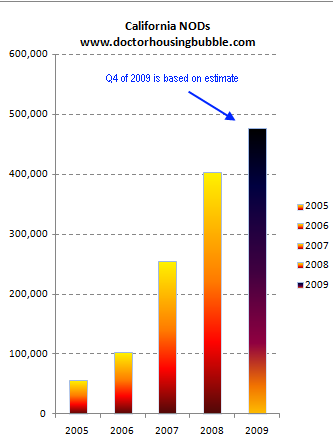
California Sending out Approximately 475,000 Notice of Defaults for 2009 yet Overall Foreclosures Declining. Shadow Inventory, Q3 Defaults, Toxic Loans. The State of the National Housing Market.

California is on path for a record 2009. By the end of the year over 475,000 notice of defaults will be sent to California homeowners. This of course is simply from lenders that actually even bother to send a notice of default. The shadow inventory is growing and we have some concrete data showing the mismanagement in the housing market. Banks for the most part are playing hot potato with bad mortgages like Alt-A and option ARMs. It is interesting to note that today, we have data showing a record number of notice of defaults for 2009 yet actual foreclosures are less than 2008. What gives? Well for Q3 we found out that the median months behind before a lender filed a NOD is 5 months. That is right, 5 months with no payment before the lender even notices.

First let us look at this trend on a chart:


yearly california notice of defaults
Source: Data Quick


The first key point is that 2009 saw more notice of defaults sent out than in 2008. In terms of housing distress, 2009 was a tougher market than in 2008. Sales have boomed but this is mostly due to the lower end of the market enticing investors and first time buyers. Throw in every incentive you can imagine and you can understand why it “feels” better. The data as you can see above shows otherwise. The Q4 data is an estimate but I lowered the number even below the current average. Given that many lenders are not even moving on some properties, we can expect NODs to probably fall again in Q4. Some lenders like Bank of America have stated that they will start moving and foreclosing on loans that don’t qualify for HAMP soon but we’ll see. I take what the banks say with a grain of salt.

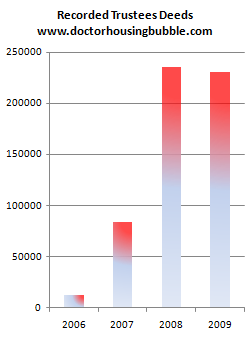
You would expect that with a high NOD and weak cure rate, that actual foreclosures would be higher this year for California. Not the case:


foreclosures california

This is a fascinating trend. A loan that enters the NOD phase in all likelihood is going to be foreclosed. But banks aren’t moving through the process in full form. In many cases this is where the shadow inventory is being built. At this point, it isn’t the REOs on the books that are a problem but loans that are sitting in a sort of mortgage purgatory. Not paying but also no NOD. Given low cure rates and the abundance of toxic mortgages in California it is a major red flag that NODs are at a record but foreclosures are falling. We now know the average foreclosure timeline is 18 months to 2 years so some of these will become foreclosures in 2010.

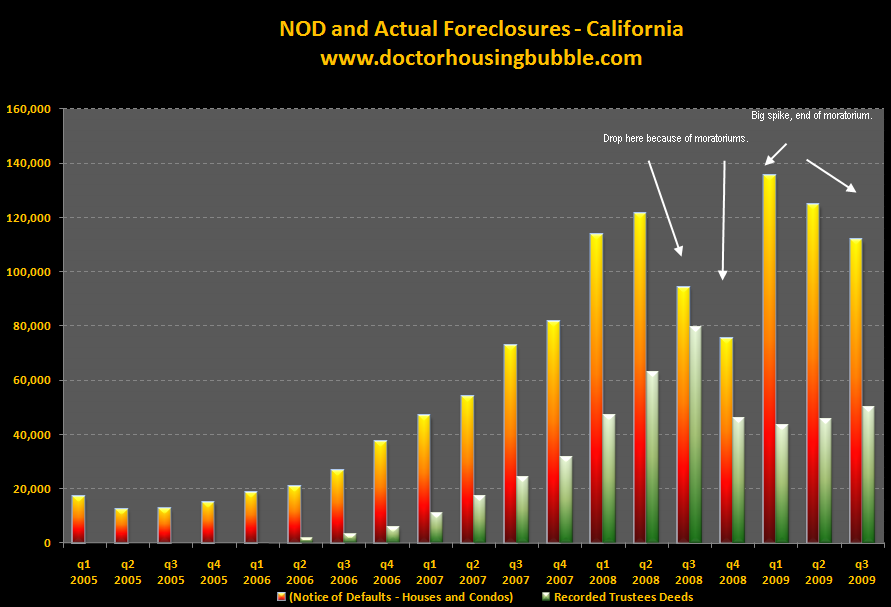
If we look at quarterly data, you can actually see this. NODs will spike followed by a jump in actual foreclosures:

california notice of defaults

You’ll see NODs spike in 2006 and 2007 followed by actual foreclosures. We see a dip in 2008 because of moratoriums but the trend emerges with one caveat. Foreclosures don’t seem to have a trend but move sideways. So what is the reason for this? Banks are largely operating with no system in place and many institutions are selectively ignoring certain non-payers. So in terms of actual data, they look fine in some areas. After all, if the bank isn’t pursuing the property why would the public care? The public should care because taxpayers now subsidize the entire banking and mortgage industry (hello FHA insured loans).

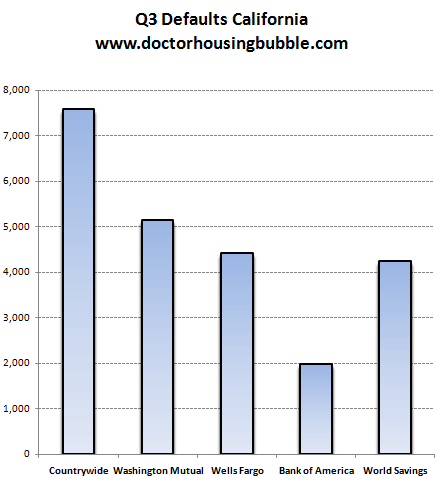
Many of our favorite toxic mortgage all-stars appear in Q3 of 2009. In fact, the largest defaulter in Q3 is now defunct Countrywide:
q3 defaults by lender california


In fact, out of the top 5 culprits only two stand in 2009 and that is Bank of America and Wells Fargo. Bank of America swallowed up Countrywide Financial and Washington Mutual is now part of Chase (as if I need to tell anyone in California with Chase’s massive marketing blitz partly subsidized by the American taxpayer). The lenders are gone but the loans are still here wrecking havoc.

Yet that is only half of the story. If we look at some of the subprime outfits we get default rates for the period of:

ResMAE Mortgage: 73.9
Ownit Mortgage: 69.5
BNC Mortgage: 61.4
Argent Mortgage: 59.9
First Franklin: 59.4

These suckers are long gone but here are their mortgages clogging up the California housing market. Is anyone going after these people criminally? Look at those rates! You have fraud factory written all over them.

Nationwide Housing Market

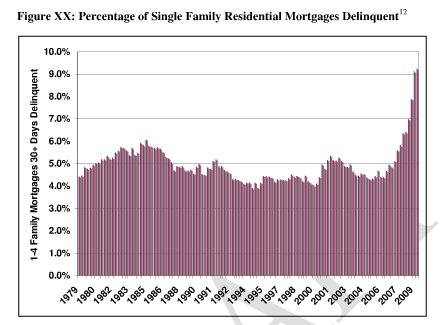
The nationwide housing market is still in deep trouble. The amount of single family homes in delinquency is an all time high:

percent of single family loans delinquent
Source: Congressional Oversight Panel

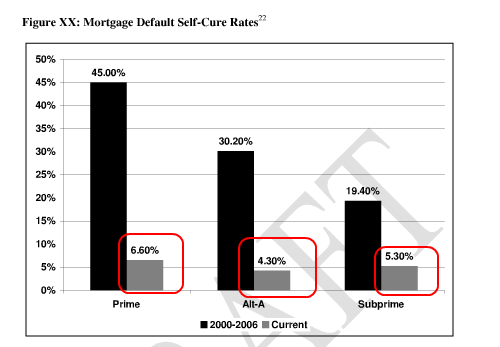
Now here is where the above California data doesn’t coincide. California has 5.3 million homes with a mortgage. Keep in mind California is in much worse shape than the overall trend. So using this data, you would expect some 530,000 homes in a form of distress. That nearly matches up with the 475,000 figure for NODs. But then, if we look at actual cure rates, we are left asking what is really going on here?
cure rates

Most of the Alt-A loans and a ton of subprime is here in California. Meaning, of the 475,000 NODs we would expect only 23,750 to cure (assuming better nationwide stats). Yet actual foreclosures are trending more in the figure of 230,000 for 2009. In other words even by this data some 200,000 homes are sitting in the California pipeline. The number is much higher because we are not looking at many homes with non-payers or strategic defaulters that have yet to even receive an NOD. Can’t track something you don’t report but we know it is happening.

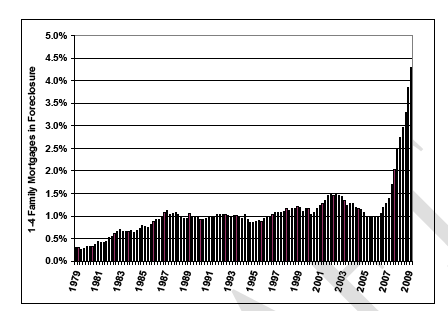
We have never had so many housing units in foreclosure:
foreclosure wave nation

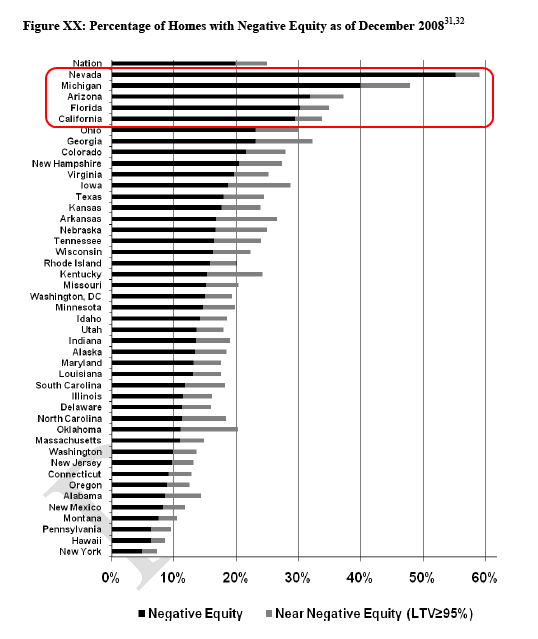
This is the trend that we should be following. So far, we have seen no major decline in actual foreclosures. Negative equity is a big reason for the defaults and California is one of the prime negative equity states:
negative equity

Source: Congressional Oversight Panel


30 percent of California homes with a mortgage are underwater (equals 1.745 million home owners/debtors). 35 percent are near negative equity. That is why pushing the 3.5 percent down with FHA loans is such a losing proposition. If homes decline say another 5 or 10 percent, there goes another batch of people into negative equity positions which increase the chance of foreclosure. The data is right here but gimmicks trump good public policy. Nationwide 20 percent of mortgages are underwater. Not good.

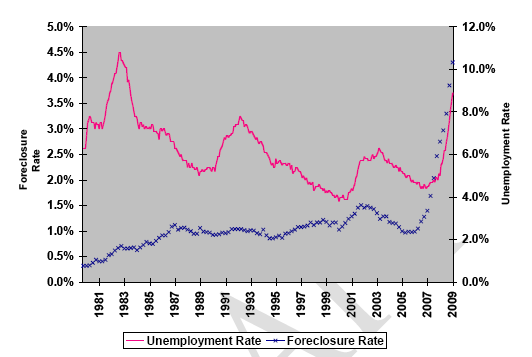
I’ve been searching for a chart that measured the overall foreclosure rate with unemployment for some time now. It would reason that higher unemployment would lead to more foreclosures. Yet that isn’t always the case:
unemployment and foreclosure rates


You’ll notice in the early 1990s recession that as unemployment went up, foreclosures merely moved sideways. In the early 1980s, unemployment shot sky high yet foreclosures modestly increase. But during this decade, housing and employment coupled. Why? Our entire economy became dependent on the housing bubble. What this meant was that wherever housing went, unemployment was sure to follow. Now, foreclosures are busting through any historical trends.

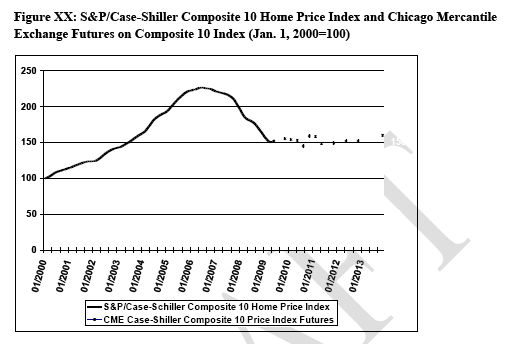
The Congressional Oversight Panel also doesn’t believe in the hype of another housing bubble:

case shiller projected
If anything, the futures market doesn’t see any price increase well into 2013. So much for the housing shills pumping up the current market. They fail to see that the recent price increase is based on:

-Moratoriums
-First time home buyers
-Investors
-$8,000 tax credit
-Fed buying $1.25 trillion in GSE MBS keeping rates artificially low

These things can’t go on forever. Those betting with actual money in the markets don’t believe this either. Why? Employment is still weak. We have a glut of housing to last us through 2013. That is why you don’t see massive home building even 2 years after the bubble burst.

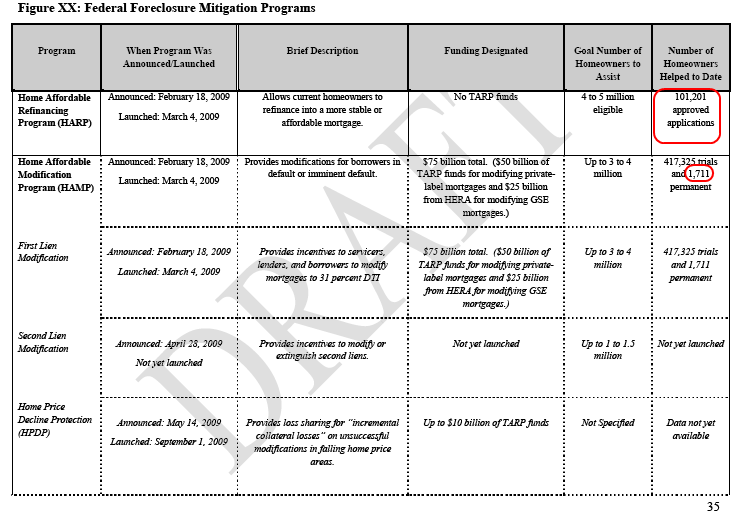
We also have an artificial amount of inventory on the market with government programs:
mod programs
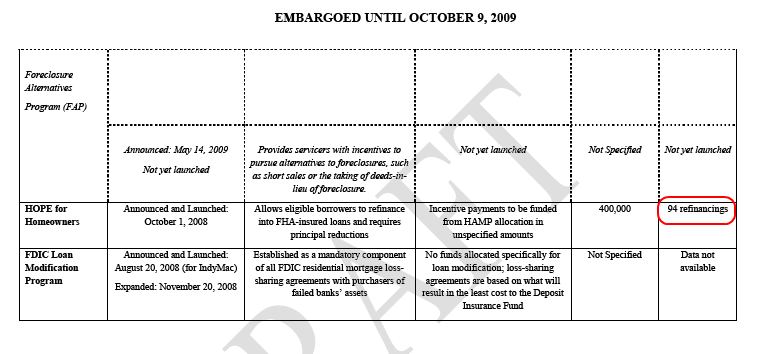
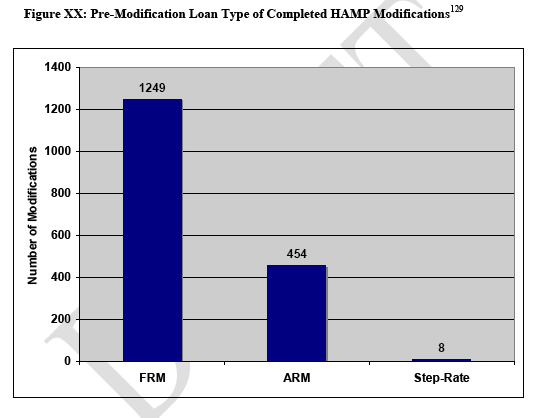
As I discussed before, the HAMP is largely a misguided program because it is based on the extend and pretend philosophy. So far, only 1,711 modifications have been permanent through HAMP. But you’ll love this data. Remember that HOPE program?
hope now
Bwahahahaha! 94 refinanced loans since the program launched in 2008! I remember talking about this back in 2007 when it was pre-launch. It turned out to be a bigger joke than even I could have imagined.

Even when we drill down in the 1,711 HAMP perm-mods, you will notice that the loans are largely fixed rate products:

hamp mods by loan type
So much for redoing those Alt-A and option ARMs here in California. By the way, good luck on getting a 31 percent ratio on some of these homes in mid to upper tier SoCal areas. These homes are underwater to the point of needing a scuba diving suit to refinance the mortgage. Plus, most people will strategically default on these places anyways. Banks on the other hand, will probably prolong the foreclosure process as long as they are sucking taxpayers dry.

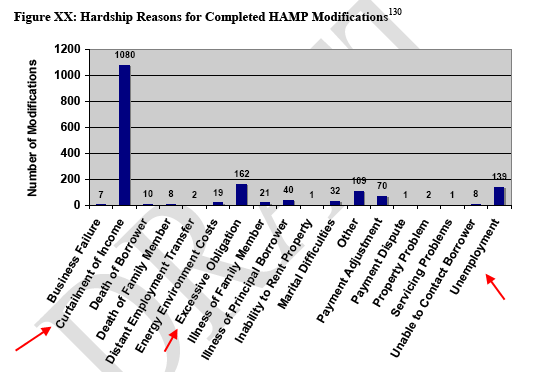
What were reasons given from the HAMP modifications?
hamp mod reasons

The top 3 reasons include, loss of income, excessive obligations, and unemployment. Basically the job market! You will not solve housing without having a solid employment base. Some people have asked me why doesn’t Wall Street and the government see this? They do. They just don’t care. Their assumption is that if Wall Street is raining, somehow some little drops will sprinkle on the poor typical American. Ask the 27 million unemployed and underemployed how happy they are that the S&P 500 is now up 62 percent from the March low. Lagging indicator? To the point of lagging you out of a decade.


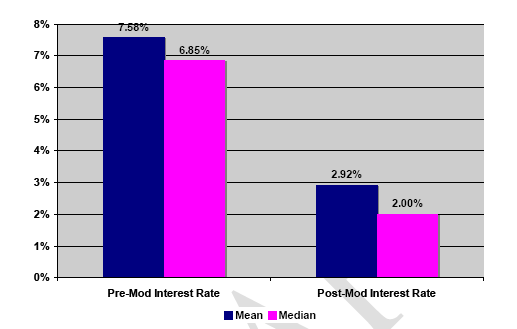
And let us look at the data of what is being done. This is the actual ruse of the HAMP mods. It is extend…
hamp loan rates
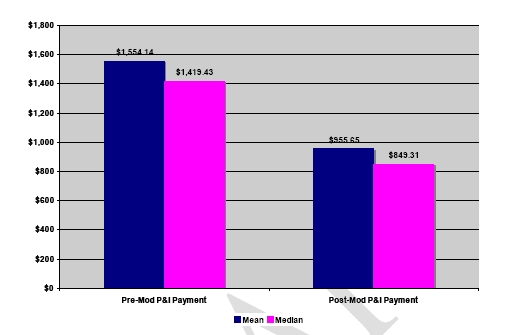
And pretend…
hamp mod PI
The loan rate is only low for a fixed time. The principal is fully intact allowing banks to claim these loans at full face value which is a crock. Without the HAMP government subsidy, these loans would need to be foreclosed. I have no problem working with homeowners only if the banks fit the bill. Yet they are so corrupt and cynical that they want the money for the mods to come from the government! Bail us out and then pay for the mods. What a load of insanity. Seriously? Enough of this and let the trials begin. It looks like a couple of hedge fund gurus are being taken down with more to follow. I’ve sent letters to Congress, called up representatives, and some agree but the sense I got from many is “what can I do?.”

Also looking at the extend and pretend, you can’t modify property taxes and insurance. These are based on the assessed value of the home which according to the bank is still up in the peak ranges. What horrible policy.

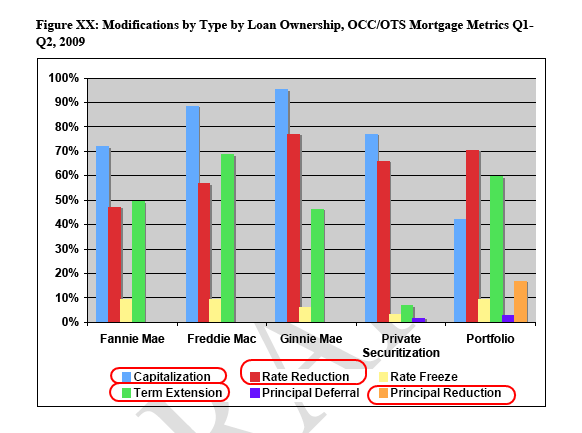
The OCC and OTS have some more data in other types of modifications:
mod by type occ and ots data
The same kind of pattern emerges as the 1,711 HAMP mods. That is, extend the term and pretend to lower the rate for a few years. You can also capitalize some of the principal on the back end rendering many of these option ARM-lites. That is why the re-default rates are through the roof. I imagine the HAMP re-default rates will be equally high. You saw the reason for payment problems. You didn’t see, “because my payment was too high” but more employment based. For those that saw reductions in their income, what if they lose their job? This is basically underwriting ala 2005 again.

People ask then what is really the solution? I’ve said it many times but you can’t have an economy without job growth. This sounds obvious but it would appear to be off the radar for Wall Street and our government. If you focus on the job situation, then housing will right itself. Notice that 1991 recession and foreclosures? What happened? Well we had the technology boom and added 20 million jobs over the decade. That was a bubble and that burst but you can see that yes, you can have an economy that runs outside of housing. But this decade housing was the economy. And the government and Wall Street basically want that industry back. Well it isn’t coming back. They need to figure out what to do.

And there is nothing wrong with renting! In fact, it is a shame that there is no actual initiative encouraging renting. Some of these people in distress will do much better to downsize. They are even telling the HAMP mod survey that they are financially strained. Maybe renting a lower priced home will help. Nothing wrong with that until you land on your feet again. Yet this notion that everyone deserves to own a home is largely a reason we are in this mess. Wall Street exploited this “American” desire and people ate it up. In fact, the dream was no longer to own a modest home but to own some oversized McMansion and drive a gigantic V-10 tank that got 8 miles per gallon. When did the American Dream become a Marvel Comic?

Some suggestions are to bring back our industrial base to the U.S. Make ourselves more competitive. Flipping homes to one another while quant jocks play Halo on one screen and do billion dollar trades on another Bloomberg Terminal is not a real economy. It basically strips the value out of the real economy. These banks posting record profits? JP Morgan making $3.6 billion last quarter. Really? Most of it was through their i-banking and private equity division. If they want to act like a hedge fund so be it but they have zero access to the Fed and U.S. Treasury. Instead, they are a primary dealer.

Healthcare is a big part of our economy and will remain that way with over 70 million baby boomers entering retirement age. Surely we can create some jobs in this arena. At least it is better than installing granite countertops in every home and adding Jacuzzis and pretending we are keeping up with technological innovations of other countries. In large part, housing has become a major distraction. It is a cultural neurosis like Tulip Mania or watching UFOs on TV taking away a kid but in the end, it is all fake. The equity in these California homes was fake. The Wall Street profits were a sham. So until we can return to a real economy, focusing on housing only serves as a form of therapy.

Copyright © 2009 Dr. Housing Bubble

Friday, November 6, 2009

Banks fall like dominoes

Banks in Ga., Mich., Minn., Mo., Calif. closed

Regulators shut banks in 5 states; marks 120 US bank failures this year

  • On 10:11 pm EST, Friday November 6, 2009

CHARLOTTE, N.C (AP) -- Regulators on Friday shut banks in Georgia, Michigan, Minnesota, Missouri, and California, bringing the number of bank failures this year to 120 amid the struggling economy and a cascade of defaults on loans.

The Federal Deposit Insurance Corp. took over United Commercial Bank in San Francisco, with $11.2 billion in assets and $7.5 billion in deposits. East West Bancorp Inc., parent company of East West Bank based in Pasadena, Calif., is buying all of the deposits and most of the failed bank's assets.

The FDIC also closed United Security Bank, based in Sparta, Ga., with $157 million in assets and $150 million in deposits; Home Federal Savings Bank in Detroit, with $14.9 million in assets and $12.8 million in deposits; Prosperan Bank, based in Oakdale, Minn., with $199.5 million in assets and $175.6 million in deposits; and Gateway Bank in St. Louis, with $27.7 million in assets and $27.9 million in deposits.

Ameris Bank, based in Moultrie, Ga., agreed to assume the assets and deposits of United Security, while Liberty Bank and Trust Co., based in New Orleans, is buying the assets and deposits of Home Federal Savings.

Alerus Financial of Grand Forks, N.D., agreed to assume the assets and deposits of Prosperan Bank, while Central Bank of Kansas City is buying the assets and deposits of Gateway Bank.

The failure of United Commercial Bank is expected to cost the federal deposit insurance fund an estimated $1.4 billion; the failure of the other four banks a combined $132.7 million.

With United Security, 21 Georgia banks have failed this year, more than in any other state. Most of the failures have involved banks in the Atlanta area, where the collapse of the real estate market brought economic dislocation. Failures also have been especially concentrated in California and Illinois.

As the economy has soured, with unemployment rising, home prices tumbling and loan defaults soaring, bank failures have cascaded and sapped billions out of the federal deposit insurance fund. It has fallen into the red.

Depositors' money -- insured up to $250,000 per account -- is not at risk, with the FDIC backed by the government. The FDIC still has billions in loss reserves apart from the insurance fund. It can also tap a Treasury Department credit line of up to $500 billion.

Last week, regulators shut nine banks owned by holding company FBOP Corp. It was a new milestone: nine was the highest number of banks closed in a day since the financial crisis began taking down banks last year. Minneapolis-based US Bancorp bought the deposits and most of the assets of the banks, which included two others in California, three in Texas, two in Illinois and one in Arizona.

Banks have been especially hurt by failed real estate loans. Banks that had lent to seemingly solid businesses are suffering losses as buildings sit vacant. As development projects collapse, builders are defaulting on their loans.

If the economic recovery falters, defaults on the high-risk loans could spike. Many regional banks, especially, hold large concentrations of these loans. Nearly $500 billion in commercial real estate loans are expected to come due annually over the next few years.

The 120 bank failures are the most in a year since 1992 at the height of the savings-and-loan crisis. They have cost the federal deposit insurance fund more than $27 billion so far this year, and hundreds more bank failures are expected to raise the cost to around $100 billion through 2013.

The number of banks on the FDIC's confidential "problem list" jumped to 416 at the end of June from 305 in the first quarter. That's the most since June 1994. About 13 percent of banks on the list generally end up failing, according to the FDIC.

The 120 failures this year compare with 25 last year and three in 2007.

To replenish the insurance fund, the FDIC wants the roughly 8,100 insured banks and savings institutions to pay in advance about $45 billion in premiums that would have been due over the next three years.

The Obama administration recently proposed a plan to provide infusions of money to small banks at low interest rates, provided they agree to increase lending to small businesses. Banks and credit unions that serve low-income areas would get aid at even lower rates to help small businesses in the hardest-hit rural and urban areas. The aid would come from money still available in the $700 billion federal bailout fund, which went mostly to large banks.

Gordon reported from Washington.